Cupcakes & Conversation with Isabelle Brouwers, First Artist, English National Ballet

Primrose Bakery supports Ballet News
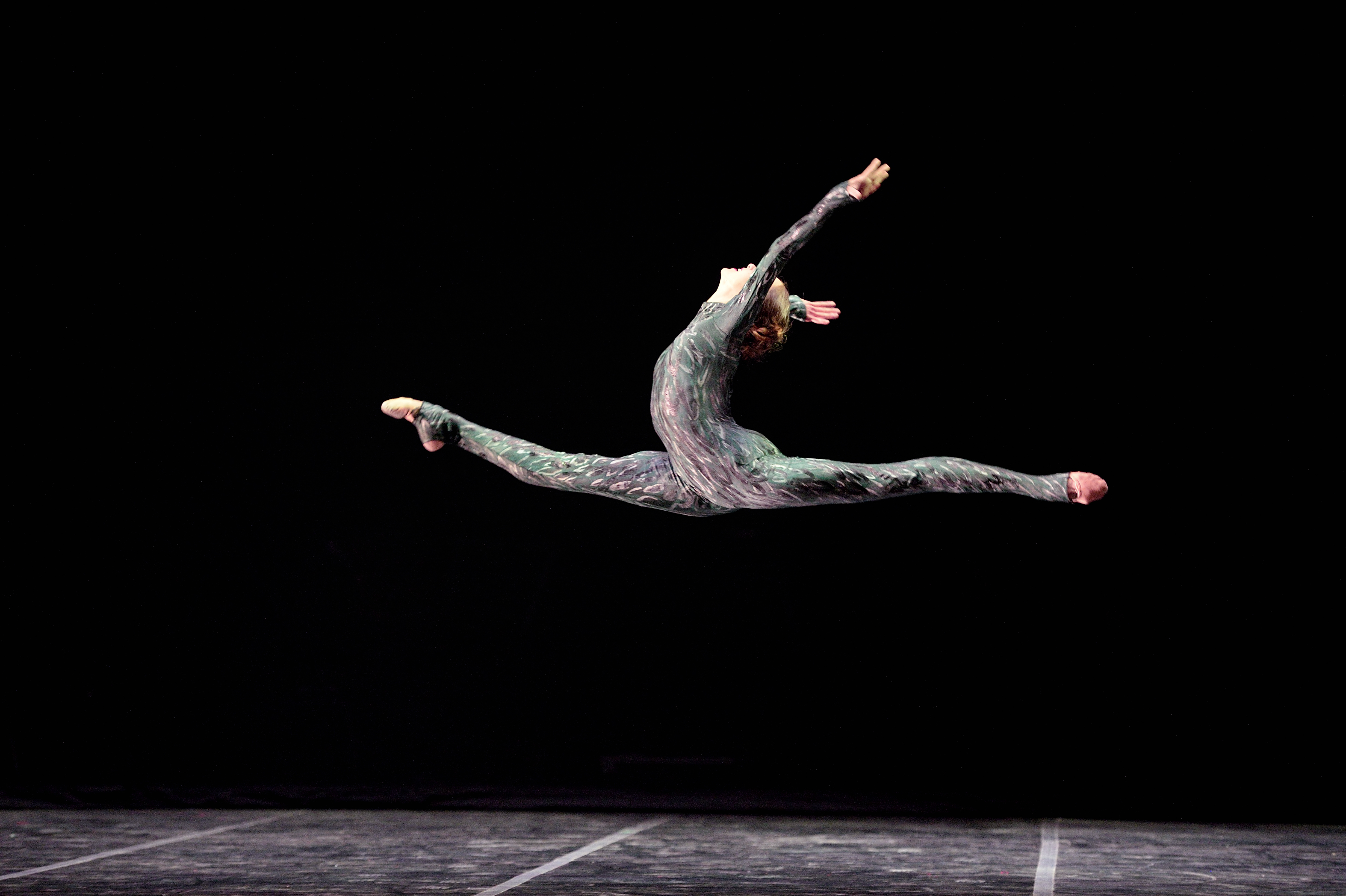
Isabelle Brouwers in new work by Charlotte Edmonds – Emerging Dancer 2016 (C) Laurent Liotardo
What motivates you at 8am on a Monday morning?
The sheer love of dance; I’m helplessly infatuated by what I do, as cheesy as that may sound! I love the freedom and joy and physical fulfilment that dance brings to me, and I find myself dancing around even when I’m on holiday. I can’t sit still for more than 5 minutes! I’m always searching for ways to improve myself and grow as an artist and knowing I have the power to take a small step towards my progress every day drives me.
If ballet chose you, as many dancers say it did, what is it that has made you stick with it?
It’s that indescribable feeling I get on stage, that power to transform into a different character, delve into a new adventure every time I perform.
You’ve been involved in making a short ballet film – how did that come about & what’s been the process?
I was very lucky and grateful to have Merrick D’Arcy Irvine contact me through social media with this film proposal and I loved his previous works so I jumped at the opportunity! It was really quite improvised, as it’s the first of a series of more spontaneous films he’s trying to create, and there wasn’t much formal preparation beforehand. Merrick had a beautiful vision of ascension, birth and transformation, like a butterfly emerging from the cocoon, and had found a wonderful piece of music that embodies this. I improvised and took my favourite movements from pieces I’ve performed to create the choreography.
How is dancing for a film different from dancing on stage in terms of your preparation and performance?
I suppose dancing for film is much more forgiving than dancing on stage! Much more preparation has to go in to a stage performance as there’s only one shot to get it correct, but in film there’s a window for experimentation as shots can be repeated multiple times. Dancing for film offers the audience a very different perspective of the movement, as so many different angles can be played with, and can create a more intimate result as close ups can fully capture the emotion. When preparing for a performance on stage, a dancer is very aware of where the front is and knows precisely where to project the movement and which angles to use to favour their lines, but on film that strict front is blurred and we have to be more aware of a 360 degree performance. There are just so many little subtle differences which create a hugely different result.
What have you learnt about from dancing on film?
It’s a big learning curve! You learn which angles work best for you, how to alter expressions and movements to change their effect from up-close as opposed to the usual distance you have from the audience on stage and you learn about the power of even the smallest subtle movements. I also have much more appreciation now for what goes on behind the lens; the cameraman has a huge responsibility and is as active as the dancer throughout the filming!
https://www.youtube.com/watch?v=shqjahwUwQs&feature=youtu.be
What are you looking forward to dancing in 2018/19 and what are the big challenges likely to be for you?
I’m really excited to perform Christopher Wheeldon’s Cinderella in-the-round at the Royal Albert Hall in June 2019. It will be an incredible production and I can’t wait to be back on the iconic enormous stage there! I’m also very excited to revisit the role of Myrtha in Akram Khan’s Giselle, a ballet which English National Ballet are performing in Chicago, Luxembourg and Moscow this season. I’ve performed it several times now in theatres as far away as Auckland, New Zealand. There’s something so powerful about the role and I love exploring and delving deeper into the character every time I perform it, finding new subtleties and new dimensions to the role. I’m very excited to revisit Pina Bausch’s incomparable The Rite of Spring at Sadler’s Wells later this season too, as part of English National Ballet’s She Persisted programme. It’s such a surreal experience dancing such a legendary piece and it truly pulls everything out of you as a performer, you end the show feeling so utterly drained but on such a high!
What do you look for in a dance partner and what would you dance?
That fun chemistry. I love what I do and I love dancing with someone who’s relaxed and is able to have fun while they’re dancing too. I love to dance with someone who truly delves into the character they’re portraying. For me, that transformative process of adopting a new character on stage is the most enjoyable part of the job and to be able to share that with your partner feels amazing.
Of course, it’s also a dream to get to dance with someone who can predict exactly where my centre of balance is and always knows how to put me on my leg! I think Kenneth MacMillan is the absolute wizard of pas de deux choreography and I’m dreaming of performing one of his iconic pas de deux one day. A personal favourite of mine is Manon and all the pas de deux in that ballet are utterly magical. I’d also absolutely love to perform one of the pas de deux in Jiří Kylián’s Petite Mort – it’s the most perfectly musical work I’ve ever seen, it seems as though Mozart choreographed it himself!
How do you prepare your pointe shoes ?
I wear Gaynor Minden pointe shoes which have been magical for many reasons, one of the main ones being their consistency, so I always know they’re going to feel comfortable and perfectly snug on my foot! I do darn my shoes which can be a challenge with the thick suede of the Gaynor shoes, but I like the look it creates. I then sew ribbons on in the spot where my foot bends so the shoe is pulled up right at the correct place for a better line, and invisible elastics.
What is your daily routine at the moment?
My daily routine is something that is ever changing and ever evolving to adapt to my different needs throughout the year depending on what we’re performing, what we’re doing in rehearsals, where we’re touring to etc … there are so many factors!
I always make sure I do class every morning; it’s my daily meditation and it’s so essential for me to wake up all those muscles properly and of course it’s absolutely vital for me to evolve and improve my technique. I’m always striving for that improvement and it’s so satisfying when you achieve that little extra goal you’d been aiming for, whether it’s as simple as feeling a new muscle working or adding an extra pirouette to a combination.
I have a little pre-class Pilates ritual which I’ve compiled and perfected over my 4 years at English National Ballet, with the help of our amazing Pilates instructors at work, to help strengthen and fine-tune the deep stabilisation muscles in the core, ankles and hips which are so essential to us ballet dancers. We also have an excellent sports science team which keeps us strong with cross-training exercises.
The rest of the day after class can vary so much for us with our extensive classical and contemporary repertoire and exciting touring schedules! Sometimes after ballet class, we end up having a full day of completely contemporary rehearsals which is amazing to improve our versatility, and so often enhances our ballet technique by allowing us to explore much wider ranges of movement. Other times we’re preparing full length classical pieces, and very often we’re powering through two performances a day! It’s great to have this ever-changing variety in our schedules, it keeps us motivated, alert and inspired and allows us to really grow as all-round artists. During our breaks we keep our bodies healthy with physiotherapy and sports massage appointments.
What do you eat during the course of a typical working day?
The menu varies hugely depending on where we are in the world and what we’re doing on stage. I’m coeliac so I have to follow a gluten free diet which is becoming easier and easier to stick to with gluten free options always available in restaurants and shops. Breakfast is probably my favourite meal so I love starting the day with a hearty meal, either something sweet based around oats, yoghurt and berries or something savoury with eggs and beans and always a coffee, preferably a sweet mocha!
Lunch and dinner are usually based around a meat option like fish or chicken, lots of vegetables (as many colourful vegetables as possible for the full rainbow of antioxidants) and a complex nutritious carbohydrate like quinoa or beans. I always carry snacks in my ballet bag for in between rehearsals, like mixed nuts and dried berries. I’m a helpless chocolate lover and we do treat ourselves to lovely treats especially during show times when we get each other nice little good luck chocolates!
You can ask six famous people to dinner – who would you invite?
Meryl Streep, Malala Yousafzai, William Forsythe, Stephen Hawking, Pina Bausch and Freddie Mercury. I think that would create a thrilling evening of arts, science, crazy laughter, empowerment and philosophical insights into life.
What is your best piece of advice ?
Listen to your body, set small weekly goals, work intelligently rather than just working hard, be observant, use every opportunity on stage to grow as an artist, there’s no small role, be patient and stay positive.
How do you prepare in the hours before a show ?
I usually have a good energising meal about 1.5-2 hours before the show, then do my hair and make up and go to stage at the half an hour call to warm-up and get my body ready for the show. If I’m performing a more featured role I prefer to get ready slightly earlier than usual to give myself more warm-up and preparation time. I like to listen to uplifting music while I’m doing my hair and make up to get my energy up and put myself in the right mindset. If I get nervous, I try and go through some simple slow breathing routines to slow the heart rate down, but I’m very lucky, with the amount of shows we perform at ENB, the stage has become a place of comfort and joy!
Which role has tested you the most and how?
Myrtha, both in the classical Mary Skeaping staging of Giselle we performed and Akram Khan’s version. The classical version is so unbelievably taxing physically with a huge amount of big jumps which requires a lot of stamina, although this is my absolute favourite part of dancing!
Maintaining the aloof, slightly sinister characterisation throughout was a challenge for a typically bubbly and smiley person like me, but I do absolutely adore the character transformation part of my job.
With Akram Khan’s version of Myrtha I was very lucky to work closely with Akram himself and really have the chance to understand the true essence of his portrayal of the character. It was a long process but I was so honoured to have the opportunity to perform the role.
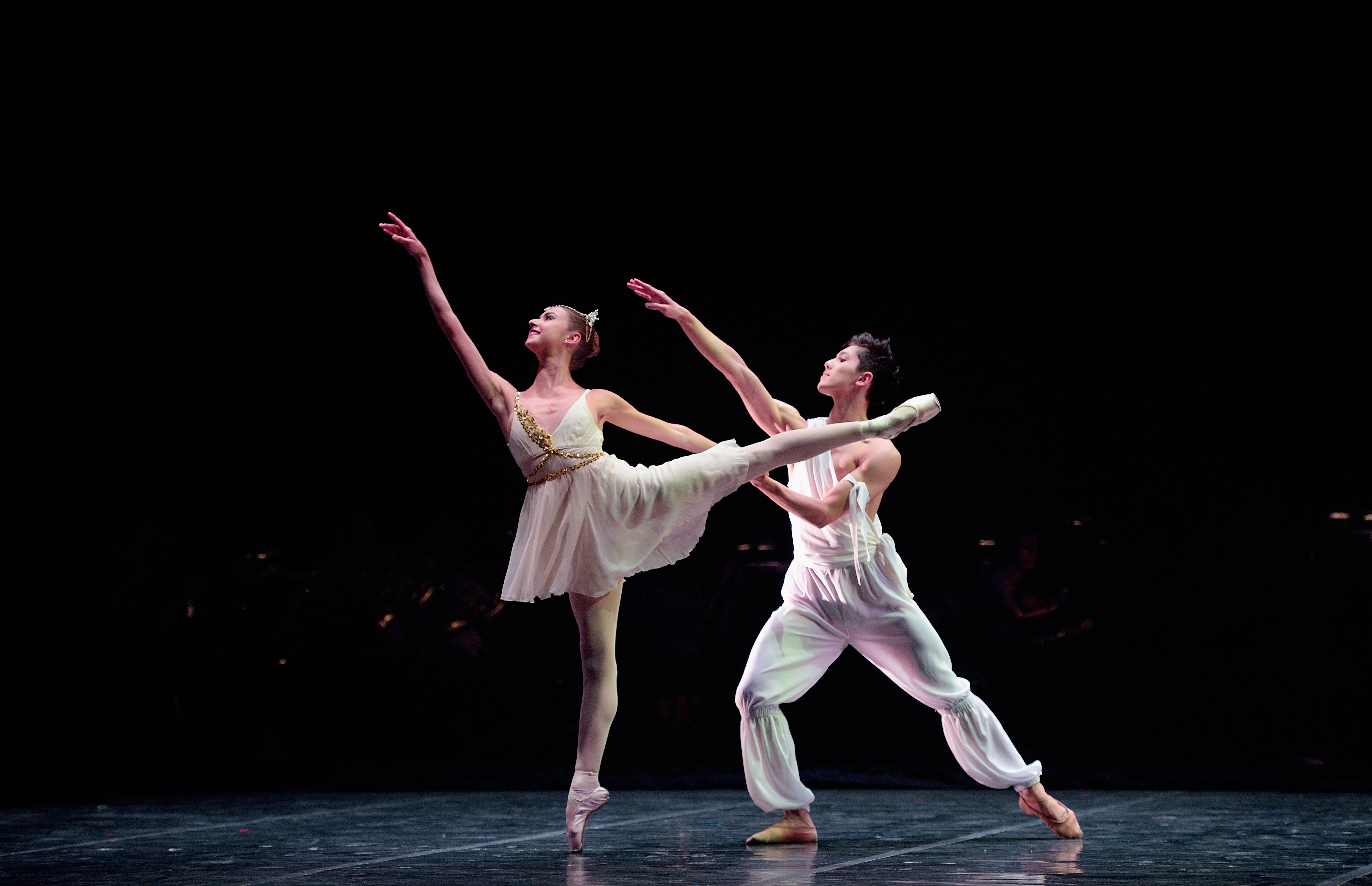
Isabelle Brouwers and Erik Woolhouse in the Talisman pas de deux – Emerging Dancer 2016 (C) Laurent Liotardo
What is your favourite quote?
‘He who has a why to live can bear almost any how’ by Nietzsche
Do you have a ‘signature step’ – one that comes naturally to you?
Grand Jetes! Grand allegro has always been my favourite.
Did you enter any competitions before becoming a professional dancer and if so, which ones, and what was your experience of them ?
I entered quite a few competitions before joining the company, including; Youth American Grand Prix, Prix de Lausanne, Young British Dancer of the Year and Genée International Ballet Competition.
For me competing was always a positive experience. Growing up in an expatriate family, I was moving country and changing ballet schools every 2 to 3 years, so competing was a wonderful way to gain exposure to enter the professional training world and increase my confidence on stage. It was also a wonderful way to network with artistic directors and renowned figures in the dance world. I was very lucky to win some medals and create a stable platform to launch myself into the professional world.
Do you have a secret skill which no-one knows about?
I guess adaptability?! I was lucky while growing up; I lived in almost every continent and managed to adapt very easily to the different cultures and pick up quite a few languages on the way! It taught me so much and allowed me to appreciate so many different ways of life and really shaped who I am today.
Who would you like to have a conversation with?
Frida Kahlo – the embodiment of perseverance and strength. She faced an unbelievable amount of adversities in life, yet she always retained a strong colourful front. She created the most striking surrealist works, and had such a strange and unbelievably fascinating mind. I’d love to be able to go back in time to talk to her and try to delve into her mind!
What is your exit strategy, for the time when you stop dancing, and how did you plan it?
I’m hoping my exit isn’t something I’ll have to plan too soon, but it’s something that is always in the back of dancer’s minds. I’m a very inquisitive and curious person and I have always been the studious type. I’m well aware of the multitude of opportunities that lie in this world and although dance and ballet will always remain part of my identity, I plan to explore the wealth of the world upon retirement from dancing.
I’m delving into online university studies in the near future and plan to study psychology or social sciences as the functionality of the human mind and the structure of society have always fascinated me. When I retire I hope to be able to pursue a career in journalism; a future dream of mine would be to work as an international correspondent for BBC or Al Jazeera, which will hopefully also satisfy the adventurous traveller blood in me!