Ballet News Reviews | Taking Flight – Michaela & Elaine DePrince

Photo by Cheryl Angear
You probably won’t recognise the name Mabinty Bangura. You may have heard of Michaela DePrince, the extraordinarily flexible dancer from Sierra Leone whose story has been published for young adults. DePrince lived in Sierra Leone, West Africa, during the civil war, and the horrors of that time form part of her incredible story. The title of the book proclaims : “from war orphan to star ballerina” and although the frequent use of the word ballerina throughout the book grates, you can’t argue with the roots of her story.
Unusually, both for the time and location, DePrince’s parents married for love, not through an arranged marriage, and both of them could read. Since DePrince was born with the skin condition vitiligo, her parents felt that passing on the ability to read and to save for her education would help their daughter more than anything, since they considered her prospects of reaching a good “bride-price” quite remote.
DePrince was able to speak five languages very early on, due to helping out on her parent’s market stall, and her reading and writing set her apart from the other children – which isn’t always easy to deal with on top of the vitiligo. DePrince wasn’t included much with the other children, but she had a happy life with her parents.
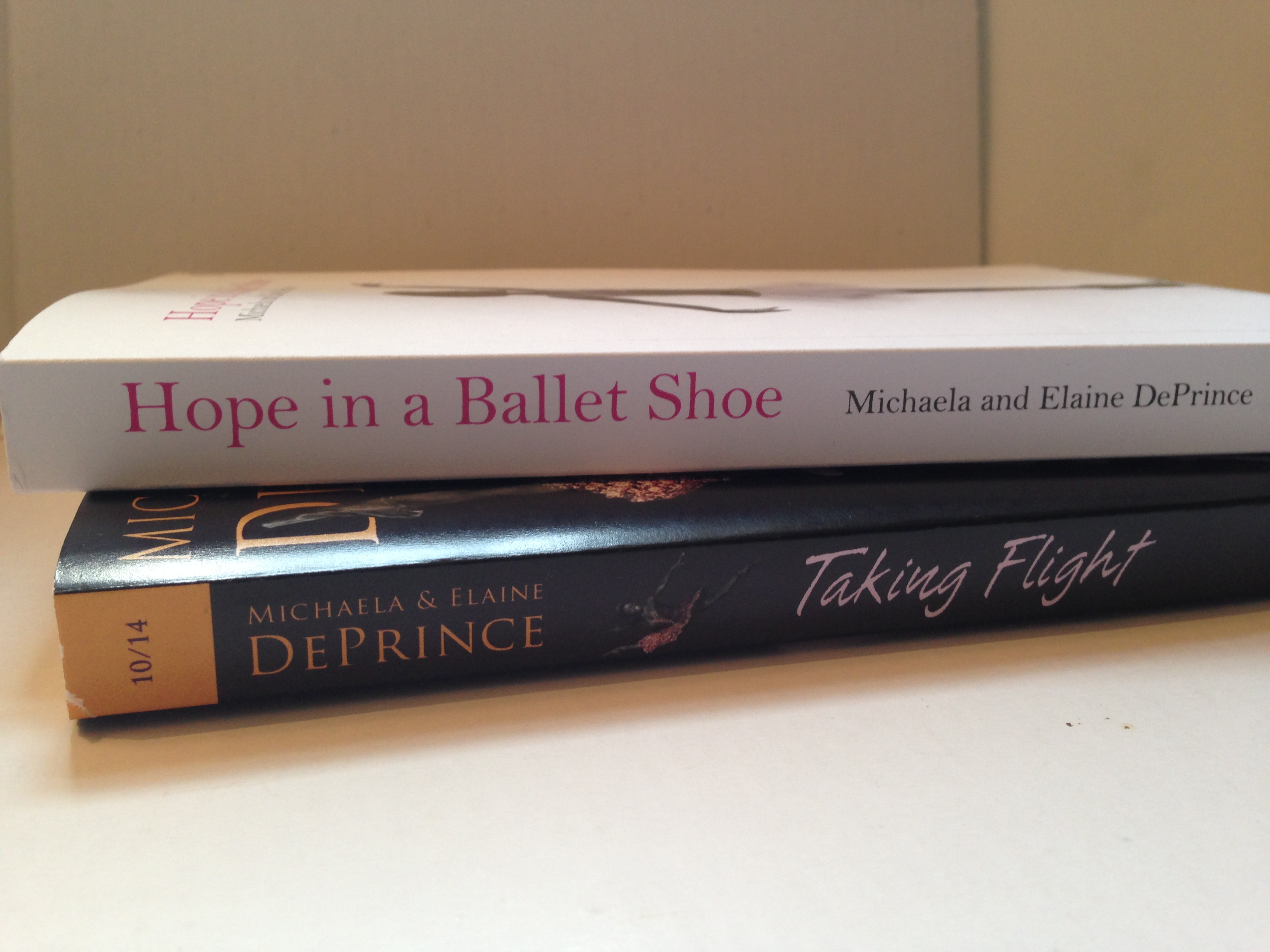
Photo by Cheryl Angear
Then the rebels killed her father at work, and later her mother died from fever because she saved as much food as they had for her daughter. These events forced DePrince onto her Uncle’s family; he had several wives and lots of children but only one (much revered) son. His wives and daughters were regularly beaten by him and this wasn’t a happy time for DePrince. After the loss of her mother, her Uncle couldn’t see any advantage in feeding and clothing her, so instead he walked her to an orphanage where she was taken in for adoption to America.
Her story takes a happy turn, but not before she suffers further at the hands of the staff in the orphanage. During this time DePrince learned how to make friends, though she herself was alienated frequently. Once adopted, DePrince takes ballet classes, learns English and integrates with her new family. Later, she competes at YAGP and earns a full scholarship to American Ballet Theatre’s Summer Intensive in New York – one of her dreams. During training, DePrince learned that the tricks she could perform easily – jumps and multiple pirouettes – might be impressive but they were not what the school, or professional ballet companies, would require of her. She learned to work on the basics, refine her technique and grow in confidence.
DePrince was inspired to take up ballet be seeing a photograph in a magazine when she lived in West Africa in the orphanage. One of her teachers (who was later murdered in front of her) explained what ballet was, and ignited in DePrince a hope that one day she too might be able to look like this dancer. It turns out that the photograph was Magali Messac who was a Principal dancer at Pennsylvania Ballet and later American Ballet Theatre.
DePrince is now dancing with Dutch National Ballet.
This book is aimed at young adults and whilst covering the important aspects of the story it does not dwell on the brutality of her early life. Instead it is a positive example of hope over adversity. One could argue that DePrince is still defining her ballet style; still learning artistry and developing her range, and that her story is incomplete. Perhaps a new chapter will follow.
[AMAZONPRODUCTS asin= “0385755112”]
[AMAZONPRODUCTS asin= “0385755155”]